

 English
 中文简体
中文简体
Turning a creative idea into a market-ready squeeze toy involves more than choosing a shape and adding a logo. Buyers need to consider design ownership, material performance, customization costs, packaging requirements, and product testing before committing to a production plan. At Hongrui, we understand that each custom toy project has different commercial goals, so the manufacturing approach should match the intended product and target market.
As a squeeze toys company, we recognize two common routes for customized products: Original Equipment Manufacturing (OEM) and Original Design Manufacturing (ODM). Both can support brand development, but they involve different levels of design control, technical preparation, and development investment. Understanding these differences helps our customers prepare clearer specifications and make informed purchasing decisions.
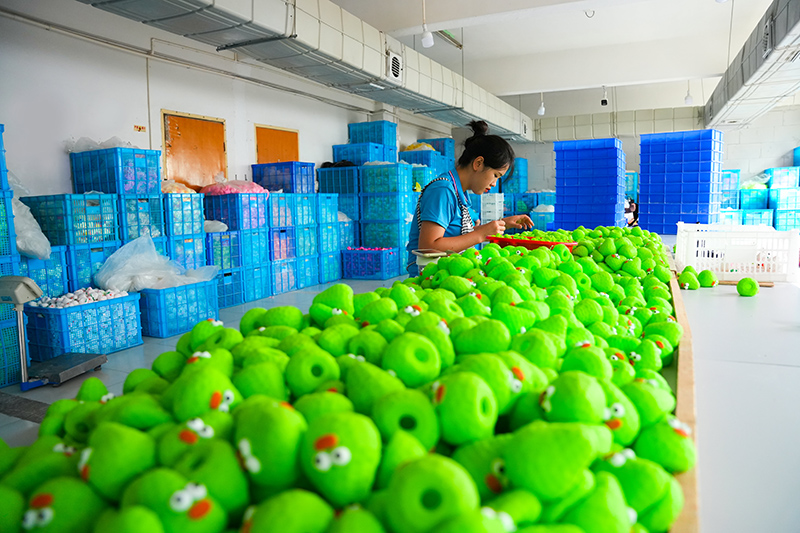
1. OEM and ODM: Understanding the Main Differences
The distinction between OEM and ODM starts with the source of the product design. One approach follows a buyer-defined concept, while the other builds on an existing design or a design developed with greater manufacturer input.
OEM: Manufacturing Based on Your Design
OEM is suitable for businesses that already have a product concept, design drawing, 3D model, or physical reference sample. Our role in an OEM project is to review the requirements, assess manufacturing feasibility, develop samples as agreed, and produce the approved toy according to the confirmed specifications.
- Shape and dimensions: Define the toy's length, width, height, contour, and intended compression behavior.
- Brand identity: Specify custom characters, surface graphics, logos, and visual details.
- Material requirements: Describe the required softness, elasticity, surface texture, and recovery behavior.
- Packaging: Provide artwork, labeling requirements, barcode details, and retail packaging preferences.
This model gives buyers greater control over product development. However, a new shape or structure may require additional mold development, prototype revisions, and technical evaluation. We recommend documenting these requirements before confirming the project budget.
ODM: Customizing an Existing Design
ODM starts with a product design or development platform already available through the manufacturer. Rather than developing every element from the beginning, buyers can discuss approved modifications to match their branding and sales objectives.
- Color customization: Request specific colors based on a physical reference or a defined color standard.
- Logo and graphics: Add approved printed details or branding elements to suitable surfaces.
- Packaging options: Develop branded boxes, printed cards, labels, or individual packaging.
- Product variations: Review available shapes, sizes, textures, and other existing design options.
ODM can simplify development because the basic product design already exists. However, the available customization range depends on the product structure and manufacturing process. Changes to the material, internal construction, or mold may require additional engineering work even with an existing design.
2. Which Manufacturing Model Fits Your Business Goals?
At Hongrui, we encourage buyers to define the purpose of their project before deciding how much customization is necessary. A promotional campaign, a retail product launch, and a proprietary character collection may require very different development arrangements.
Consider OEM for a Distinctive Product Line
OEM is worth evaluating when the product itself is central to your brand identity. A retailer developing an original mascot, for example, may need a custom silhouette, carefully defined proportions, and specific facial details that cannot be achieved through a standard catalog design.
- Original product concepts: Your team has drawings, reference images, or a clearly documented design brief.
- Greater design control: Shape, dimensions, surface details, and other product characteristics need specific approval.
- Long-term brand planning: Your business intends to build a recognizable product range around a distinct design.
- Defined ownership requirements: Your company needs written agreements covering original artwork, tooling, and permitted use of the finished design.
Before starting, we suggest preparing a development budget that separates design work, tooling, samples, testing, packaging, and production. This makes the financial commitment easier to evaluate against projected sales.
Consider ODM for Flexible Product Development
ODM can be a practical route for buyers who have a clear market concept but do not need an entirely new product structure. An importer planning a range of animal-shaped squishy toys, for example, may be able to start with existing designs and customize the colors, graphics, and packaging.
- Limited design resources: Your team needs manufacturing guidance on available shapes and customization possibilities.
- Controlled development spending: You want to compare existing product options before investing in new tooling.
- Product range testing: You plan to evaluate customer responses to different designs before expanding the range.
- Brand presentation: Packaging and visual identity are important, while the existing product structure remains suitable.
ODM does not automatically guarantee a lower unit price or unrestricted customization. Actual costs depend on the selected product, order volume, material requirements, printing method, packaging, and any requested modifications. We recommend reviewing a project-specific quotation rather than relying on general pricing assumptions.
3. Technical Details Buyers Should Define Before Sampling
A squeeze toy must deliver the intended tactile experience while maintaining suitable physical integrity during normal use. Vague descriptions such as “soft,” “slow rising,” or “high quality” are difficult to evaluate consistently without a reference or measurable acceptance criteria.
Our recommendation is to create a product specification that separates appearance, physical performance, and packaging requirements. The exact parameters should be established according to the selected material and construction.
| Specification | Details to Confirm | Purpose |
| Dimensions | Length, width, height, and dimensional tolerances | Maintains consistency across samples and production units |
| Material | Material type, formulation requirements, and applicable safety restrictions | Defines the physical properties and compliance requirements |
| Softness | Reference sample, compression force, or an agreed evaluation method | Clarifies the intended squeezing experience |
| Recovery behavior | Recovery time or agreed performance criteria after compression | Provides a repeatable way to assess the product's response |
| Surface finish | Texture, color reference, print placement, and acceptable visual variation | Supports appearance consistency |
| Packaging | Packaging dimensions, artwork, labels, and protective requirements | Aligns the finished product with retail and shipping needs |
For example, a buyer requesting a slow-rising foam squeeze toy should provide a reference for the desired recovery behavior. A proposed evaluation method could record the time required for a sample to return to an agreed shape after compression under defined conditions. The test method and acceptance range must be confirmed for the specific material; a universal recovery-time figure should not be assumed.
Material selection also deserves careful attention. Polyurethane foam and other elastomeric or flexible materials do not necessarily provide the same compression response, surface feel, durability, or manufacturing requirements. We assess material options according to the intended construction rather than assuming that one material fits every design.
4. Sample Approval and Quality Control
A product image can communicate the general appearance of a toy, but it cannot fully demonstrate softness, elasticity, surface quality, or recovery behavior. Physical samples therefore play an important role in our custom development process.
We recommend using a staged approval workflow to reduce uncertainty before bulk production.
- Stage 1 — Confirm the brief: Record the target dimensions, material expectations, colors, artwork, packaging, intended users, and destination market.
- Stage 2 — Review the initial sample: Check shape, appearance, compression response, surface condition, and any visible manufacturing defects.
- Stage 3 — Record revisions: Document changes to dimensions, graphics, material, or other approved characteristics. Use version numbers to distinguish revised samples.
- Stage 4 — Approve the production reference: Confirm the physical sample and written specifications that will govern manufacturing.
- Stage 5 — Verify production consistency: Agree on inspection criteria, sampling procedures, defect classifications, and the handling of nonconforming units.
Safety and compliance checks must also match the destination market and intended age group. Applicable requirements may cover restricted substances, mechanical or physical hazards, labeling, and product traceability. Custom colors, coatings, printing, materials, and structural changes may affect the assessment. Buyers should verify the relevant requirements and documentation for the final product rather than assuming that existing reports automatically cover every variation.
5. Protect Your Design, Mold, and Branding Rights
Customization creates commercial value only when the responsibilities and usage rights are clearly understood. OEM and ODM describe manufacturing arrangements, but those terms alone do not determine ownership of every design element.
Before authorizing development, we recommend confirming the following points in writing:
- Design ownership: Identify the owner of original artwork, 3D files, product designs, and any newly developed elements.
- Mold ownership: State who pays for custom tooling, who owns it, where it is stored, and whether it may be used for other projects.
- Exclusivity: Define whether a design is exclusive, non-exclusive, or restricted by territory, customer category, or contract period.
- Brand permissions: Confirm that the buyer has authorization to use all supplied logos, character artwork, and licensed materials.
- Revision control: Specify how design changes are approved and how outdated files or samples are handled.
These details are particularly important for character-based squeeze toys and promotional products. Paying for a custom mold does not automatically settle every question about intellectual property or future use. Written terms help both parties understand their obligations throughout the project.
6. Prepare a Clear Custom Squeeze Toy Inquiry
Our team at Hongrui can assess a project more effectively when the initial inquiry includes practical information instead of a general request for a customized toy. A complete brief also makes it easier to compare OEM and ODM proposals on a consistent basis.
- Product concept: Share sketches, reference photos, 3D files, or links to relevant existing designs.
- Customization scope: Identify the required changes to shape, color, texture, printing, material, and packaging.
- Target specifications: Provide dimensions, preferred physical characteristics, and any defined performance criteria.
- Order plan: State the expected order volume, number of design variations, and anticipated repeat-order pattern.
- Market information: Identify the destination country, intended user group, labeling needs, and applicable compliance expectations.
- Commercial priorities: Explain whether design exclusivity, development spending, packaging presentation, or launch scheduling carries greater weight.
With these details, we can review the proposed manufacturing route, identify information that still needs confirmation, and discuss the relevant sample and quotation arrangements. Project costs, production schedules, and feasible order conditions depend on the actual specifications and must be confirmed individually.
Match the Manufacturing Model to Your Product Strategy
OEM and ODM serve different purposes in custom squeeze toy development. OEM offers greater control over a buyer-defined design, making it suitable for original product concepts and distinctive brand collections. ODM allows buyers to work from existing designs and customize selected details, which can be useful for testing product ideas or developing branded ranges without creating every element from scratch.
At Hongrui, we believe a successful project starts with clear requirements, realistic technical specifications, an agreed sample approval process, and written commercial terms. Our team at decompressiontoy.net welcomes inquiries from brands, distributors, promotional merchandise buyers, and retailers planning customized squeeze toys. Share your concept, target market, customization requirements, and expected order volume with us so we can discuss a suitable development approach for your project.
 +86-159 8313 8795
 No. 188, Weisi Road, Licun Village, Xiaoshun Town, Jindong District, Jinhua, Zhejiang, China