

 English
 中文简体

Material selection plays an important role in the purchasing and development of stress relief toys. Different customers expect different tactile experiences, product structures, and durability levels. Promotional gift distributors may prioritize lightweight designs and printing compatibility, while retailers may focus on softness, appearance, and repeated-use performance. Choosing a suitable material requires understanding how its physical properties match the intended application.
At Hongrui, we work with customers to evaluate product requirements before confirming manufacturing details. A stress relief relax toy can involve different material structures, including flexible rubber-like compounds, polyurethane foam, and silicone. Each option has distinct characteristics that influence product design, production methods, and purchasing costs.
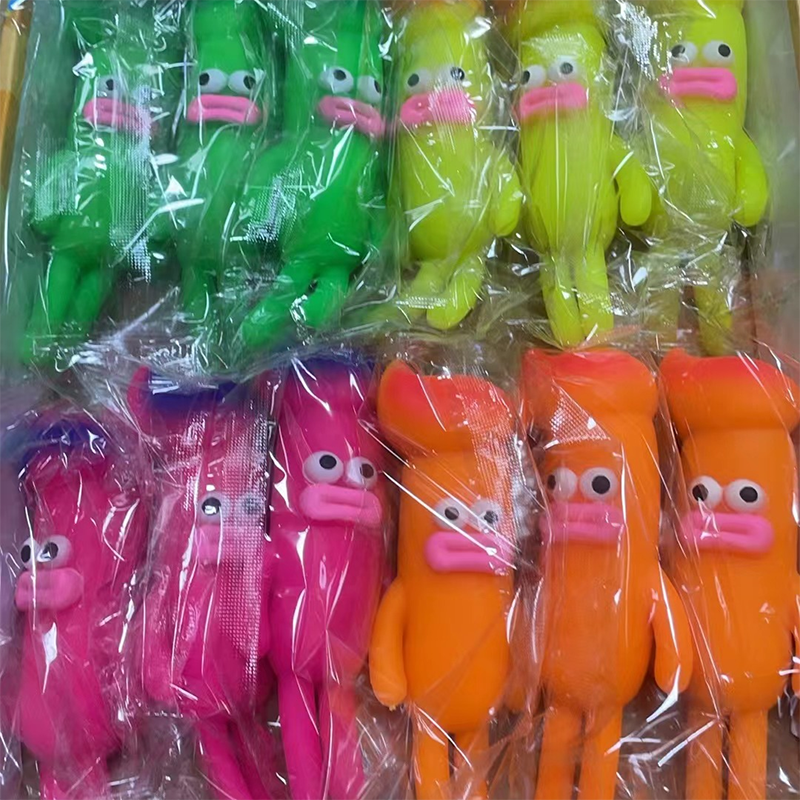
1. PU Foam for Slow-Rising Squeeze Toys
Polyurethane (PU) foam is widely used in soft squeeze toys, character-shaped products, and promotional stress relievers. Its compressible structure allows the product to deform under hand pressure and gradually recover after release.
This material is particularly suitable for applications requiring a lightweight body and a soft, cushioning feel.
- Slow-recovery response: Different foam formulations and densities create different recovery speeds after compression.
- Lightweight construction: Foam structures are convenient for promotional products and retail merchandise.
- Shape flexibility: PU foam can be manufactured into animals, food shapes, cartoon characters, and customized promotional designs.
- Surface finishing: Coatings and decorative treatments can create different colors and visual effects.
For bulk purchasing, we recommend confirming foam density, recovery behavior, surface coating, and dimensional consistency. Buyers should also examine resistance to tearing and coating cracks through sample evaluation. These details are particularly relevant to products expected to undergo repeated squeezing.
2. TPR and TPE for Flexible Sensory Designs
Thermoplastic rubber (TPR) and thermoplastic elastomer (TPE) are common material choices for flexible sensory toys and soft squeeze products. Their elasticity supports different tactile experiences, ranging from gentle compression to stretching and squeezing.
These materials can suit novelty toys, soft animal shapes, food-inspired designs, and products with flexible outer structures.
- Elastic flexibility: TPR/TPE compounds can provide a soft, flexible feel with different degrees of rebound.
- Design versatility: Different formulations support various shapes, surface textures, and color combinations.
- Flexible construction: Some designs use a hollow shell or combine an outer layer with an internal filling.
- Surface characteristics: Material formulation affects tackiness, grip, odor, and resistance to deformation.
For TPR/TPE products, we suggest checking material hardness, wall thickness, filling compatibility, and seam integrity where applicable. A material that feels soft during an initial inspection may behave differently after repeated compression or extended storage. Buyers should evaluate samples under conditions that reflect their intended usage.
3. Silicone for Elastic and Reusable Products
Silicone is another option for stress relief products requiring flexible construction and a smooth tactile surface. It can be molded into solid or hollow designs, depending on the intended product structure and manufacturing process.
Silicone-based products are often considered for reusable sensory accessories, textured squeeze toys, and designs requiring repeated deformation.
- Elastic response: Silicone formulations can provide flexible deformation and recovery.
- Surface feel: Different finishes can create smooth, matte, or textured surfaces.
- Cleaning considerations: Certain silicone formulations are suitable for washable product designs, subject to the actual product construction and care instructions.
- Molding flexibility: Silicone molding supports customized shapes, textures, and decorative details.
Buyers should confirm the silicone grade, hardness, curing process, pigment system, and intended use. Food-contact suitability or other special safety claims must be supported by relevant documentation and testing rather than assumed from the material name.
4. Match Material Properties with Purchasing Requirements
Comparing materials becomes easier when buyers establish clear product requirements before requesting quotations. The following overview provides a practical starting point for supplier discussions.
| Material | Typical Characteristics | Suitable Applications | Important Checks |
| PU Foam | Compressible, lightweight, slow or variable recovery | Character toys, promotional stress relievers | Density, rebound, coating, tear resistance |
| TPR/TPE | Flexible, elastic, soft tactile response | Sensory toys, novelty squeeze products | Hardness, wall thickness, seams, odor |
| Silicone | Elastic, moldable, flexible surface | Reusable sensory products, textured squeeze toys | Compound, curing, hardness, surface finish |
There is no universal material specification for every application. Product dimensions, internal construction, expected compression frequency, decoration methods, and packaging conditions can all influence the final material choice.
5. What Should Buyers Confirm Before Ordering?
At Hongrui, we recommend preparing a clear purchasing brief to help connect material selection with manufacturing requirements. Several details deserve attention before sample approval and bulk production:
- Target application: Identify whether the product is intended for retail sales, corporate gifts, promotional campaigns, or sensory activities.
- Physical specifications: Provide preferred dimensions, weight, hardness, and tactile characteristics where available.
- Visual requirements: Confirm colors, surface textures, printed graphics, and customized shapes.
- Quality expectations: Discuss compression testing, dimensional tolerances, surface defects, and material consistency.
- Compliance requirements: Identify the destination market, intended age group, and applicable toy safety testing.
- Packaging arrangements: Confirm individual packaging, labeling, carton dimensions, and shipping requirements.
We also recommend comparing physical samples rather than relying exclusively on material descriptions. Sample testing provides a clearer understanding of softness, recovery, appearance, and handling characteristics.
Discuss Material Requirements with Hongrui
Material decisions affect more than the initial product feel. They influence molding methods, surface treatments, customization possibilities, inspection procedures, and overall purchasing arrangements.
At Hongrui, we help customers review different product requirements and discuss suitable manufacturing options for their stress relief toy projects. Whether you need lightweight PU foam designs, flexible TPR/TPE products, or elastic silicone constructions, our team can discuss the relevant specifications, samples, and customization details.
Explore our product range or contact Hongrui with your preferred material, design references, and purchasing requirements. We welcome inquiries from wholesalers, distributors, promotional gift suppliers, and brands looking for manufacturing cooperation.
 +86-159 8313 8795

 No. 188, Weisi Road, Licun Village, Xiaoshun Town, Jindong District, Jinhua, Zhejiang, China
