

 English
 中文简体
中文简体
Consumer interest in flour filled squishy toys has increased due to their soft tactile feedback and dough-like resistance. A common concern appears repeatedly across user feedback: whether flour filled stress balls can leak during normal squeezing activity. The answer depends on the structure design, sealing quality, and how the internal powder behaves under stress.
How Flour Behaves Inside a Sealed Elastic Shell
- Flour consists of fine starch particles ranging roughly 10–100 microns
- Particles move freely and redistribute under compression pressure
- Internal air gaps gradually reduce with repeated squeezing cycles
- Moisture absorption can cause slight clumping inside sealed spaces
Flour does not behave like liquid gel or solid foam. It functions as a dry granular system that shifts position with every squeeze. This movement creates a soft resistance effect, but it also means that pressure is not distributed evenly inside the shell. Areas under repeated compression experience more internal friction and stress.
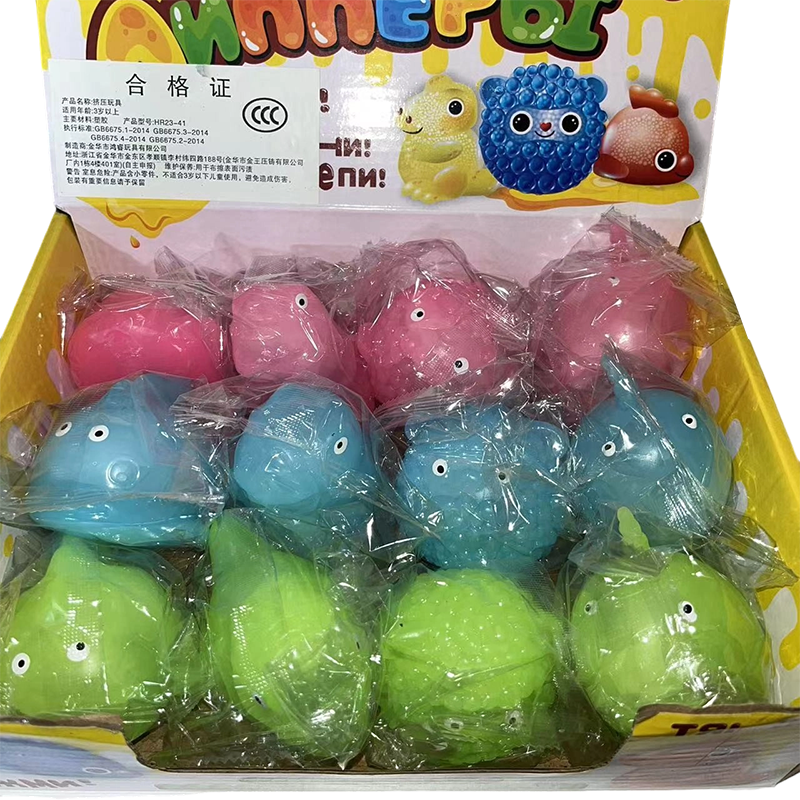
Why Leakage Risk Exists in Flour Filled Designs
- Fine powder can escape through microscopic pinholes in the outer layer
- Seam joints remain high-risk zones for structural fatigue
- Repeated twisting increases strain near filling ports
- Elastic aging reduces sealing tightness over time
Flour filled stress ball leakage is rarely caused by sudden failure. More often, it begins with tiny structural weaknesses that gradually expand. Powder particles are small enough to pass through gaps that would still contain gel or foam. This makes even minor shell imperfections more noticeable compared with other filling types.
Outer Shell Strength and Real-World Durability Factors
Material Construction and Thickness Range
- Common outer materials include latex, TPE, and silicone blends
- Wall thickness usually ranges between 1.0 mm and 2.5 mm
- Double-layer designs reduce early-stage leakage risk
- Injection or knot sealing areas remain structurally weaker
A well-made flour filled stress ball relies heavily on the integrity of its outer membrane. Even high-quality shells gradually lose elasticity after repeated stretching cycles. The weakest points are typically not the central surface but the seams and filling closure areas where stress concentrates during repeated compression.
Usage Intensity and Wear Progression
- High-frequency squeezing accelerates micro-tear formation
- Pinching at one fixed point increases localized stress damage
- Twisting motions place uneven torque on sealing areas
- Extended daily use reduces elasticity recovery capacity
Consumer discussions and repair experiences show that stress balls used lightly often last significantly longer than those under constant pressure. Even without visible damage, internal fatigue builds gradually inside the shell material, eventually allowing fine powder escape.
Environmental Influence on Leakage Probability
External Conditions Affecting Material Stability
- Heat exposure softens and weakens elastomer structures
- UV light accelerates surface aging and micro-crack formation
- Humidity can influence flour consistency and clumping behavior
- Dust and oil accumulation reduce surface elasticity over time
Environmental stress often acts as a silent contributor to leakage. A stress ball kept in stable indoor conditions typically maintains its integrity longer than one exposed to sunlight, temperature changes, or high humidity environments. These factors do not immediately cause failure but gradually reduce material resilience.
Leakage Patterns Observed in Flour Filled Stress Balls
Common Early Warning Signs
- Fine dust appearing near seam or grip areas
- Slight change in firmness or uneven resistance
- Visible thinning of outer elastic layer
- Small particles escaping after strong compression
Unlike gel-filled products that often produce immediate sticky leaks, flour filled stress ball leakage usually starts subtly. Powder may escape in small amounts long before any obvious rupture occurs. This gradual pattern makes early detection more difficult but also allows users to notice warning signs before full failure.
User Handling Behavior and Product Longevity
How Daily Use Influences Leakage Risk
- Gentle squeezing significantly reduces stress concentration
- Avoiding sharp fingernail pressure helps preserve shell integrity
- Rotating grip positions distributes wear more evenly
- Allowing recovery time between use cycles improves elasticity retention
User behavior plays a major role in whether leakage develops early or remains absent for a longer period. Even well-manufactured products can fail prematurely under aggressive use patterns. Conversely, moderate handling can extend functional lifespan noticeably.
Overall Leakage Assessment
Flour filled stress balls do not inherently leak easily under normal, moderate use conditions. However, leakage risk exists due to the fine particle nature of flour and the mechanical limitations of elastic shells. Most issues originate from seam fatigue, micro-punctures, or long-term material aging rather than sudden structural failure. Careful handling and stable storage conditions significantly reduce the likelihood of powder escape during daily use.
 +86-159 8313 8795
 No. 188, Weisi Road, Licun Village, Xiaoshun Town, Jindong District, Jinhua, Zhejiang, China